2026–2027 Sermon Notes Journal KDP
For pastors, ministry leaders, theological educators, and serious lay preachers, capturing insights, structuring messages, and tracking spiritual growth across a liturgical or academic year demands consistency—not just intention. The 2026–2027 Sermon Notes Journal KDP meets that need with a practical, production-ready interior designed specifically for self-publishing on Amazon Kindle Direct Publishing. It’s not a generic notebook template. It’s a purpose-built, bleed-ready PDF file optimized for print-on-demand workflows—tested directly in KDP’s previewer and validated for trim accuracy, margin integrity, and color fidelity.
What You Actually Get—and Why It Matters
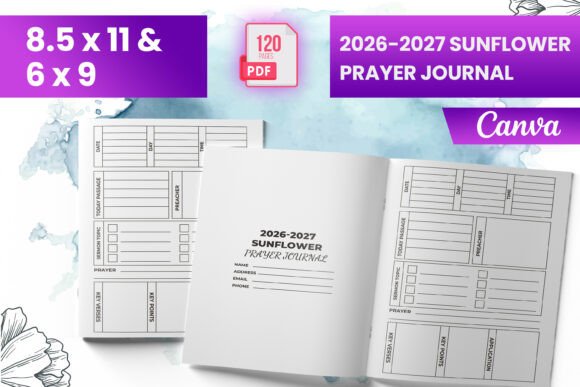
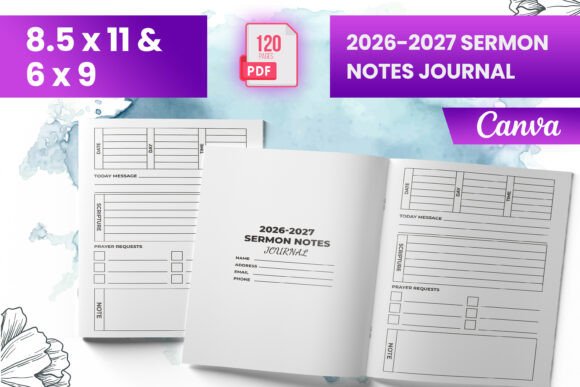
The package includes one ready-to-upload PDF interior file sized at 6″ × 9″, 8.5″ × 11″, and other standard KDP dimensions—meaning no resizing, cropping, or layout guesswork. That saves time and avoids common formatting pitfalls like text cutoff or misaligned headers. The 120-page count balances depth with usability: enough space for weekly sermon prep across two full years (2026 and 2027), yet lean enough to avoid overwhelming blank pages or excessive printing costs.
The interior begins with a clean intro page—functional, not decorative—giving users immediate orientation without sacrificing professionalism. All files include PNG and JPG assets, which is useful if you plan to customize cover elements, create social media graphics, or adapt sections for digital use outside KDP (e.g., Canva-based presentations or internal training decks). Crucially, the interior is bleed-ready: it extends background elements and design elements 0.125″ beyond the trim edge, preventing white borders on physical copies—a detail many creators overlook until their first proof arrives.
Real-World Usability in Ministry and Teaching Contexts
In practice, this journal works best when integrated into a repeatable preparation rhythm. For example, a pastor leading Sunday services may use the dated weekly spreads to log Scripture references, key illustrations, pastoral application notes, and follow-up action items—all within a single, consistent structure. Educators teaching homiletics or biblical interpretation can assign the journal as a required tool for students to document sermon analysis, rhetorical breakdowns, or exegetical observations across multiple preaching assignments.
The layout avoids over-engineering. There are no rigid fill-in-the-blank prompts that constrain thinking, nor are there overly sparse pages that leave users guessing how to organize content. Instead, the interior offers structured flexibility: lined and blank sections coexist, margins support marginalia, and spacing accommodates both concise bullet points and reflective paragraphs. This reflects real note-taking behavior—not idealized productivity theory.
Quality and Reliability: Tested, Not Assumed
Unlike many templates marketed with vague claims of “KDP compatibility,” the 2026–2027 Sermon Notes Journal KDP explicitly states that files were tested on Amazon KDP. That means actual upload attempts, preview generation, and verification of spine width calculations against page count and paper type. It also implies attention to KDP’s current requirements—including CMYK color mode for interiors (where relevant), embedded fonts, and PDF/X-1a compliance—though the listing doesn’t specify technical metadata, the testing claim suggests awareness of those fundamentals.
That level of validation matters most when scaling. If you’re publishing multiple journals—or bundling this with a companion devotional guide or preaching workbook—you reduce the risk of repeated rejections or manual corrections. For freelancers designing for church clients or small publishers managing multiple KDP titles, reliability here translates directly into fewer support tickets, faster turnaround, and more predictable timelines.
Who Benefits Most—and Where It Fits Workflow Gaps
This journal serves three primary user groups well:
- Pastors and ministry staff who want a printed, tactile resource for sermon development but lack time or design skills to build one from scratch;
- Educators and seminary instructors seeking affordable, standardized tools for students—especially in hybrid or distance-learning contexts where physical notebooks provide continuity across platforms;
- Independent Christian publishers and content creators building niche resources around preaching, biblical literacy, or spiritual formation—where a professionally formatted interior reduces production friction and elevates perceived value.
It’s less suited for users needing heavy customization mid-process (e.g., dynamic auto-populated dates or interactive PDF fields), since the delivered file is static. Nor does it replace comprehensive sermon software like Logos or Accordance—but rather complements them by offering an analog or print-first alternative for reflection, editing, or collaborative review away from screens.
Flexibility Beyond Print: Canva Integration and Digital Utility
The inclusion of PNG and JPG files expands utility beyond KDP. These raster assets allow quick adaptation in Canva for creating presentation slides, workshop handouts, or social media visuals tied to specific sermon series. For instance, a youth pastor could extract a clean section header graphic and overlay it with a Bible verse quote for Instagram, maintaining visual consistency across platforms. Similarly, a blogger documenting their preaching journey might repurpose blank journal pages as printable PDF downloads for email subscribers—without licensing concerns, since the files are yours to use.
That cross-platform flexibility supports creators who operate across print, digital, and live formats. It also lowers the barrier for non-designers: you don’t need Adobe InDesign to make meaningful adjustments. A basic familiarity with Canva or even PowerPoint is sufficient to generate polished derivatives.
Practical Considerations and Limitations
While the 2026–2027 Sermon Notes Journal KDP delivers strong baseline functionality, users should keep a few realistic constraints in mind. First, the dated nature of the journal means it’s optimized for the 2026–2027 cycle—not reusable year after year without manual date adjustment. Second, although the PDF is bleed-ready, users adding custom covers must ensure those also meet KDP’s bleed and safety margin specs separately; the interior alone doesn’t guarantee full book compliance. Third, while the 120-page count works for most preaching schedules, those preparing multiple sermons per week—or leading large teams requiring shared documentation—may find they need supplemental volumes or digital backups.
Finally, the absence of editable source files (e.g., InDesign or Canva-native versions) limits deep structural changes. You can annotate or highlight the PDF, but modifying grid layouts, font families, or page numbering requires external tools and design knowledge.
A Thoughtful Tool for Intentional Preparation
The 2026–2027 Sermon Notes Journal KDP stands out not because it reinvents note-taking, but because it removes friction from a well-established practice. It respects the time, discipline, and theological rigor involved in sermon preparation—while delivering something tangible, professional, and immediately deployable. For those who value clarity over clutter, consistency over novelty, and practicality over polish, it fills a quiet but persistent gap: the need for a trustworthy, no-surprises interior that works as promised, on the first upload.