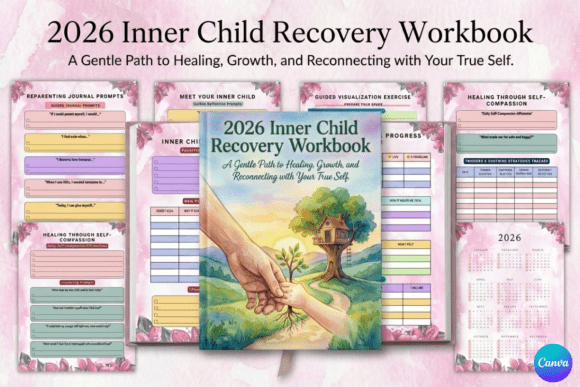
2026 Inner Child Recovery Workbook: A Gentle, Evidence-Informed Path to Lasting Emotional Healing
Healing isn’t about erasing the past—it’s about returning to yourself with kindness, curiosity, and courage. The 2026 Inner Child Recovery Workbook is more than a journal; it’s a compassionate, structured companion for anyone ready to deepen self-awareness, soothe old wounds, and cultivate lasting inner safety. Designed for both beginners and those already engaged in therapy or personal growth work, this 120-page guided workbook meets you where you are—with clarity, gentleness, and practical support.
What Is Inner Child Work—and Why Does It Matter Today?
“Inner child” refers to the emotional, sensory, and relational parts of ourselves formed in childhood—the vulnerable, joyful, fearful, or unmet aspects that continue to shape our reactions, relationships, and self-talk well into adulthood. Inner child work isn’t nostalgia or regression. It’s a evidence-informed therapeutic practice rooted in attachment theory, somatic psychology, and internal family systems (IFS). Clinicians and trauma specialists increasingly recognize that unresolved childhood experiences—whether from overt abuse, chronic neglect, inconsistent caregiving, or subtle emotional invalidation—can manifest as anxiety, people-pleasing, perfectionism, emotional numbness, or difficulty setting boundaries.
In our fast-paced, digitally saturated world, many adults feel emotionally disconnected—not just from others, but from their own needs, intuition, and joy. The 2026 Inner Child Recovery Workbook responds to this need with intentionality: it doesn’t ask you to “fix” yourself quickly. Instead, it invites slow, embodied reconnection—page by page, breath by breath.
How This Workbook Supports Real, Sustainable Healing
Unlike generic journals or motivational planners, this workbook is built on clinically relevant frameworks—adapted for accessible, self-guided use. Each section flows organically from awareness to integration:
- 📅 2026 Calendar Pages — Not just for scheduling appointments, but for tracking healing rhythms: when you felt grounded, when a trigger arose, or when a small act of self-care shifted your day. Consistency—not perfection—is the goal.
- 🌼 Meet Your Inner Child — A grounding invitation to reflect without judgment: What brought you comfort at age 7? What made you feel unseen at 12? These questions build emotional literacy—the foundation of self-regulation.
- 🎨 Draw or Visualize Your Inner Child — Art-making bypasses the critical mind. You don’t need drawing skills—just willingness. A scribble, a color, a symbol can unlock feelings words haven’t yet reached.
- 💔 Child Wound Assessment — This isn’t about assigning blame or reliving pain. It’s a compassionate inventory: Where were your needs unmet? What beliefs formed (“I’m too much,” “I must stay quiet to be safe”)? Naming them reduces their unconscious power.
- 💖 Self-Compassion Practices — Backed by research from Dr. Kristin Neff, these prompts help shift from self-criticism to supportive presence. Example: “What would I say to my best friend if they shared this feeling?” Then—say it to yourself.
- 👶 Reparenting Prompts — Perhaps no caregiver told you, “Your feelings matter.” This section helps you offer that truth now: “I see how hard that was. You didn’t deserve to handle it alone.” Reparenting isn’t fantasy—it’s neural rewiring through repeated, embodied practice.
- 💌 Healing Letters — Writing to your younger self builds empathy across time. A letter *from* your inner child surfaces unspoken needs. A forgiveness letter (not necessarily to others—but to yourself for surviving) releases shame-based residue.
- 🔥 Triggers Soothing Strategies Tracker — Triggers aren’t flaws—they’re data. This tracker helps you notice patterns (“Every time I get criticized at work, I shut down”) and test calming tools (“3 minutes of box breathing helped 70% of the time”). Over time, your nervous system learns new responses.
Who Benefits Most From This Workbook?
This resource is especially valuable for:
- Adults in therapy — Use it between sessions to deepen insights, prepare reflections, or gently explore topics you’re not yet ready to voice aloud.
- Survivors of complex or developmental trauma — Its paced, non-linear design honors how healing unfolds—not in straight lines, but in waves and spirals.
- Empaths and highly sensitive people — Many absorb others’ emotions because they learned early that their own weren’t safe to express. This workbook rebuilds that boundary from within.
- Creatives and caregivers — Artists, teachers, nurses, and parents often pour out energy without refilling. Inner child work restores creative spark and sustainable compassion—for others and yourself.
- Anyone navigating life transitions — Divorce, career shifts, grief, or even joyful milestones (like becoming a parent) can stir up buried childhood material. This workbook offers gentle scaffolding.
Common Misunderstandings—Clarified
Myth: “Inner child work is only for people with ‘big T’ trauma.”
Truth: Developmental wounds—including emotional invisibility, conditional love, or growing up in high-pressure households—impact nervous system development just as profoundly. This workbook supports all forms of relational and attachment healing.
Myth: “I’ll get overwhelmed revisiting the past.”
Truth: The 2026 edition intentionally avoids forced catharsis. Prompts include grounding cues (“Pause. Feel your feet on the floor.”), optional skip instructions, and emphasis on choice—empowering you to pace your process safely.
Myth: “This is just positive thinking or spiritual bypassing.”
Truth: Authentic inner child healing honors grief, anger, and confusion—not just warmth. The workbook includes space for rage letters, tear-stained pages, and “I don’t know yet” reflections. Healing includes the full spectrum of human emotion.
Why the 2026 Edition Stands Out
This isn’t a repackaged version of older journals. The 2026 Inner Child Recovery Workbook integrates contemporary insights:
- With-bleed design — Full-page prompts let creativity flow edge-to-edge, reducing visual clutter and inviting spaciousness.
- Neurodivergent-friendly layout — Clear typography, generous margins, and intuitive section breaks reduce cognitive load.
- Shadow work integration — Gently explores disowned parts (e.g., the “angry child,” the “perfect student”) without pathologizing them—honoring their protective role.
- Therapy-aligned language — Avoids vague terms like “let go” or “manifest.” Instead: “Notice what arises without needing to change it,” or “Where do you feel that belief in your body?”
Begin Where You Are—No Preparation Required
You don’t need to understand your childhood perfectly to begin. You don’t need to remember everything—or anything specific. Start with one question: What does my heart need to hear today? Maybe it’s “You’re allowed to rest.” Maybe it’s “That scared part of you is welcome here.” The 2026 Inner Child Recovery Workbook holds space for all of it—without demand, without hurry.
Healing isn’t about arriving at a finished state. It’s about building daily practices that whisper, again and again: You belong—to yourself. Whether you’re journaling with morning tea, using prompts during therapy homework, or gifting it to a loved one beginning their own journey, this workbook meets you with softness, structure, and unwavering respect.
Ready to reconnect? The first page isn’t about the past—it’s an invitation to arrive, just as you are.