Perfectionism Control Workbook: A Calm, Practical Path Away from Self-Criticism
Perfectionism often masquerades as ambition—but beneath its polished surface lies chronic self-doubt, exhaustion, and the quiet erosion of joy. If you’ve ever canceled plans to rework a presentation one more time, avoided starting a project for fear it won’t be “right,” or felt shame after a small mistake, you’re not broken—you’re caught in a well-worn perfectionistic loop. The Perfectionism Control Workbook meets you there—not with rigid rules or lofty ideals, but with gentle, evidence-informed tools designed to soften the grip of control and reconnect you with what truly matters: presence, progress, and self-kindness.
More Than a Workbook—A Thoughtfully Designed Experience
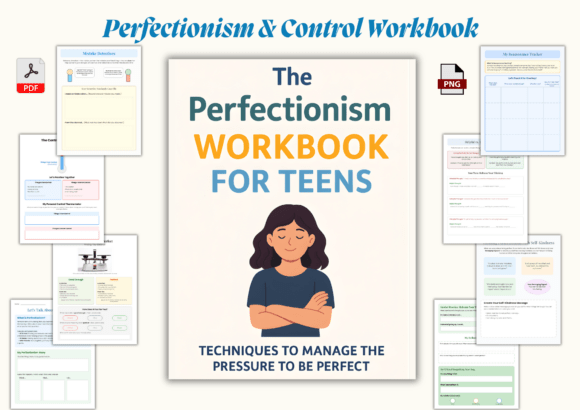
This isn’t a dense clinical manual or a generic journal. The Perfectionism Control Workbook is intentionally crafted for emotional resonance and practical use. Measuring a comfortable 8.5 x 11 inches, it balances spaciousness with intention—giving your thoughts room to breathe while guiding focus where it’s needed most. Available in both PDF and PNG formats, it adapts seamlessly to your workflow: print it for tactile reflection, annotate digitally for on-the-go insights, or display pages as calming visual anchors in therapy offices or classrooms.
The soft watercolor aesthetic isn’t just decorative—it’s functional. Muted washes of sage, sky blue, and warm taupe create visual calm, reducing cognitive load before you even begin writing. Minimal silhouettes—gentle outlines of hands holding notebooks, trees with open branches, figures sitting quietly—invite identification without prescriptive storytelling. Even the back-cover pattern repeats subtly across worksheets, reinforcing cohesion and psychological safety. In a world saturated with sharp edges and high-contrast stimuli, this design choice supports nervous system regulation from the first glance.
What’s Inside—and Why It Works
Rooted in Cognitive Behavioral Therapy (CBT) principles—but translated into accessible, human language—the Perfectionism Control Workbook moves beyond theory into daily practice. Each section responds to real struggles:
- Understanding Perfectionism: Not as a personality trait, but as a learned coping strategy—often formed in childhood environments where love felt conditional on performance. This section helps users recognize their unique “flavor” of perfectionism (e.g., approval-seeking, avoidance-driven, or self-punishing) without judgment.
- Control Thermometers: Simple, visual self-assessment tools that help users notice when their need for certainty spikes—and what triggers it (e.g., ambiguous feedback, open-ended deadlines, or social uncertainty). These aren’t diagnostic, but they build crucial metacognitive awareness.
- Mistake Reflection Tools: Structured prompts that shift attention from “What went wrong?” to “What did this teach me—and what would I say to a friend in this situation?” This builds neural pathways for self-compassion, not just correction.
- “Good Enough” Mindset Practices: Concrete experiments—like submitting work at 90% completion or sending a text without editing three times—that gently stretch tolerance for imperfection. Progress isn’t measured in outcomes, but in willingness.
- Emotional Regulation Strategies: Grounding exercises paired with body-awareness cues (e.g., “Where do you feel tightness when you think ‘I must get this perfect’?”), helping users interrupt the physical escalation that often precedes burnout.
Real-Life Applications: Who Benefits—and How
The Perfectionism Control Workbook serves diverse needs—not as a one-size-fits-all fix, but as a flexible companion:
- Teens navigating academic pressure: One high school counselor reported that students using the workbook’s “Progress vs. Perfection” tracking templates began identifying study habits tied to anxiety—not ability—leading to more sustainable routines.
- Adults in creative or leadership roles: A freelance graphic designer shared how the “Mistake Reflection” page helped her reframe a client revision request as collaborative refinement—not personal failure—reducing pre-submission panic.
- Therapists and counselors: Used between sessions to reinforce concepts like cognitive restructuring or behavioral activation, the workbook offers ready-to-use handouts that align with CBT, ACT, and compassion-focused approaches—no extra prep required.
- Parents supporting perfectionistic teens: The “Self-Kindness Scripts” section gives caregivers concrete phrases to model (“It’s okay to try and adjust—that’s how learning works”), shifting family communication patterns over time.
- Mental health educators: Classroom-ready activities—like the “Healthy Productivity Balance-Building Prompts”—spark discussion about societal expectations, social media comparison, and redefining success beyond grades or output.
Strengths—and Honest Considerations
A key strength of the Perfectionism Control Workbook is its refusal to pathologize. It names perfectionism as an adaptive response—not a disorder—making it easier for users to engage without shame. The emphasis on *small*, repeatable actions (e.g., “Circle one thought that feels kinder than your usual self-talk today”) lowers the barrier to entry, especially for those overwhelmed by traditional self-help demands.
That said, it’s not a substitute for clinical support in cases of severe anxiety, OCD, or depression where perfectionism functions as a symptom rather than a standalone pattern. Users experiencing persistent hopelessness, physical symptoms like insomnia or appetite changes, or thoughts of self-harm should seek licensed mental health care. The workbook complements therapy—it doesn’t replace it.
Also worth noting: its minimal design, while soothing for many, may feel too sparse for learners who thrive on detailed instructions or visual step-by-step guides. Those users benefit most when pairing it with brief facilitator guidance—or using the included “How to Use This Workbook” orientation page to set personalized intentions before diving in.
Making It Work for You
Suitability depends less on “who you are” and more on “where you are right now.” Ask yourself:
- Do I respond to visuals and gentle pacing? If bold fonts, dense text, or aggressive motivational language drain you, this workbook’s aesthetic and tone will likely feel like relief.
- Am I ready to observe—not immediately fix—my patterns? Its power lies in building awareness first. Jumping straight to “how to stop” may miss the foundational work the workbook invites.
- Do I value flexibility over structure? There’s no required sequence. You can start with “Emotional Regulation Strategies” during a stressful week, then return to “Understanding Perfectionism” when things settle—honor your rhythm.
One therapist shared how she uses the Perfectionism Control Workbook with clients recovering from burnout: “We don’t ‘complete’ pages—we revisit them. A client might draw in the same ‘Control Thermometer’ three weeks in a row, and the subtle shifts in their color choices or annotations tell us more than any verbal summary ever could.”
A Final Note: Progress Isn’t Linear—And That’s the Point
Healing from perfectionism isn’t about becoming “perfectly imperfect.” It’s about cultivating enough safety within yourself to pause, breathe, and choose curiosity over criticism—even once a day. The Perfectionism Control Workbook doesn’t promise transformation overnight. It offers something quieter, and deeper: permission to begin again, softly, without fanfare. Whether you’re a teen facing college applications, a parent modeling resilience, or a professional rebuilding boundaries, its pages hold space—not demands. And sometimes, that space is where real change begins.