Your 2026 Life Coaching Journal: A Living System for Intentional Growth
Most planners treat time as a container to fill — appointments, deadlines, tasks. Your 2026 Life Coaching Journal treats time as terrain to traverse with awareness, intention, and care. It’s not a static schedule or a passive logbook. It’s a responsive, layered system designed to evolve alongside your thinking, values, and lived experience over the course of a full year. Unlike generic digital calendars or minimalist bullet journals, this journal embeds evidence-informed frameworks directly into its structure — making reflection, recalibration, and growth habitual rather than occasional.
How Structure Shapes Self-Awareness
The architecture of Your 2026 Life Coaching Journal begins with the understanding that clarity doesn’t emerge from busyness — it emerges from deliberate pauses, pattern recognition, and recurring inquiry. Its layout is built around cyclical rhythms: annual visioning flows into monthly calibration, which informs weekly grounding and daily alignment. This mirrors how real-life change unfolds — not in linear sprints, but in overlapping waves of insight, action, and integration.
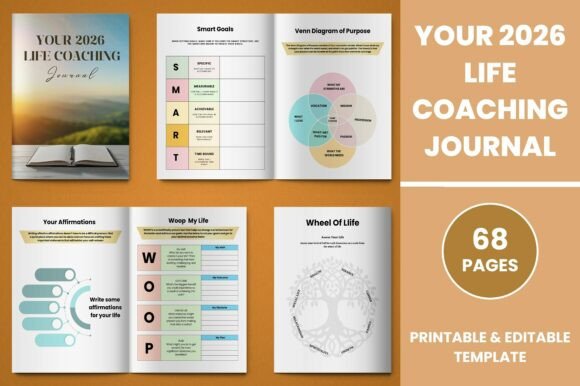
Take the Wheel of Life — a foundational self-discovery tool included in the journal. Rather than presenting it once as a static assessment, the journal revisits it quarterly, inviting users to compare shifts across domains like career, relationships, health, and personal growth. Over time, this reveals subtle imbalances before they become crises — for example, a steady decline in “leisure” scores paired with rising “workload” markers may signal burnout long before symptoms surface. Educators use this pattern-tracking to adjust workloads before semester fatigue peaks; small business owners spot when “financial planning” consistently ranks low, prompting proactive budget workshops instead of reactive crisis management.
Likewise, the Venn Diagram of Purpose isn’t a one-time exercise. It appears early in the journal and reappears mid-year — not to replicate answers, but to measure resonance. When a freelance designer fills it out in January (“What I’m good at: visual storytelling. What the world needs: ethical branding. What energizes me: collaborative ideation”), then returns in July and finds “collaborative ideation” replaced by “structured solo flow,” that discrepancy becomes data — not failure. It signals a natural evolution in values or capacity, informing decisions about client selection, team building, or even sabbatical planning.
Goal-Setting That Honors Human Complexity
Your 2026 Life Coaching Journal moves beyond SMART goals as a checklist and situates them within a broader ecosystem of motivation and constraint. The journal includes three distinct goal frameworks — each serving a different cognitive need:
- Annual Anchors: Broad, value-aligned statements (e.g., “Cultivate grounded leadership”) that act as filters for opportunity and energy allocation.
- SMART Action Loops: Not just “Specific, Measurable…” but embedded with “Obstacle Anticipation” and “Support Mapping” prompts — acknowledging that execution depends as much on environment as intent.
- Micro-Commitments: Daily or weekly “one thing I’ll do to honor my anchor” entries — small enough to sustain, meaningful enough to reinforce identity.
This layered approach reflects research in behavioral psychology: long-term goals require both aspirational framing *and* micro-feedback loops. A researcher using the journal might set an Annual Anchor of “Communicate science accessibly.” Their SMART Loop could be “Record and publish six 90-second explainer videos by October, using Canva templates and peer feedback.” Their Micro-Commitment? “Spend 12 minutes today scripting one video intro — no editing, no polish, just voice and core idea.” Each layer reinforces the other without demanding perfection.
Mindfulness Woven Into Routine — Not Added On
Gratitude, affirmation, and self-care sections avoid the trap of performative positivity. They’re integrated with functional purpose. The daily gratitude log pairs each entry with a “Why this matters now” line — transforming rote listing into contextual meaning-making. A nurse documenting “grateful for quiet hallway moments” adds “Because it’s where I reset before entering high-stakes rooms,” turning observation into self-regulation strategy.
Affirmation pages aren’t pre-written mantras. They’re guided prompts: “What would my most compassionate self say to me about [current challenge]?” or “What strength did I use yesterday that I haven’t named yet?” This grounds affirmations in lived experience, not aspiration — increasing neural uptake and reducing resistance common with generic phrases.
The self-care planner operates on a tiered model: “Non-Negotiables” (e.g., 7 hours sleep, hydration), “Restorative Practices” (e.g., 20-minute walk, analog reading), and “Reconnection Rituals” (e.g., weekly call with mentor, monthly nature immersion). This acknowledges that self-care isn’t monolithic — it must adapt to capacity, season, and role. A homeschooling parent might prioritize “Non-Negotiables” during exam weeks, shift to “Reconnection Rituals” during summer, and rotate “Restorative Practices” based on energy levels.
Habit Tracking That Reveals Systems — Not Just Behavior
The health and habit tracker goes deeper than checkboxes. Water intake logs include space for “How did this affect my focus/energy/mood?” Mood tracking uses a dual-axis scale (energy + outlook) rather than singular “happy/sad” labels — capturing complexity (e.g., high-energy + low-outlook = agitation; low-energy + high-outlook = restful contentment). Menstrual cycle tracking integrates symptom notes *alongside* productivity patterns — helping creators identify optimal windows for deep work versus brainstorming, or guiding educators to align lesson planning with natural cognitive ebbs.
Crucially, the journal links habit data to reflection: “What changed in my environment when this habit strengthened?” or “When did I skip this — and what need was unmet instead?” This transforms tracking from surveillance into systems thinking. A software developer noticing consistent water intake drops on days with back-to-back Zoom calls doesn’t just resolve to “drink more” — they redesign their meeting hygiene: scheduling hydration breaks, using visible bottles, or negotiating shorter blocks.
Creative Reflection as Strategic Practice
The vision board and mind map sections reject the notion that creativity is separate from strategy. Vision boards include prompts like “What does ‘enough’ look, sound, and feel like in this area?” and “What boundary would make this vision sustainable?” — preventing aspiration from becoming extraction. Mind maps begin not with “What do I want?” but “What assumptions am I holding about what’s possible?” — surfacing limiting beliefs before ideation begins.
To-do lists are intentionally unoptimized. They include columns for “Energy Required,” “Alignment With My Anchor,” and “What Happens If I Don’t Do This?” This forces triage rooted in values, not urgency. A nonprofit director reviewing a list might deprioritize a “high-urgency” donor follow-up if it scores low on alignment and high on energy drain — freeing space for relationship-building activities that sustain long-term mission fidelity.
Who Benefits — and How Context Changes Use
Your 2026 Life Coaching Journal serves widely because its design honors context, not uniformity. Professionals use it to translate corporate goals into personal leadership development. Creators treat it as a studio log — mapping inspiration sources, creative blocks, and audience resonance alongside output. Educators adapt reflection prompts for student-led goal-setting or curriculum design. Researchers apply its pattern-tracking to qualitative data analysis or grant-writing timelines. Even hobbyists find utility: a gardener tracks bloom times, soil conditions, and emotional response to seasonal shifts — revealing connections between environmental variables and personal rhythm.
The journal’s flexibility comes from its intentional scaffolding: every section includes optional prompts, blank space for adaptation, and cross-references (e.g., “Refer to your Venn Diagram on p. 42 when reviewing monthly priorities”). It assumes users will annotate, tear, paste, and personalize — not follow rigidly. A business owner might tape a cash flow chart beside their financial goals; a writer might glue manuscript snippets into the reflection space; a caregiver might use the chore tracker to co-plan with aging parents.
Building Resilience Through Recalibration
Perhaps the most distinctive feature of Your 2026 Life Coaching Journal is its built-in permission to pivot. Monthly review pages don’t ask “Did I achieve my goals?” but “What did I learn about my capacity, resources, and values?” Weekly reflections include “What surprised me this week — and what does that reveal?” This normalizes adjustment as intelligence, not failure. When global events shift priorities — market volatility, health changes, family needs — the journal provides structure to process impact *before* recommitting, not after exhaustion sets in.
For instance, a university lecturer whose Annual Anchor was “Expand open-access scholarship” might pause mid-year when caregiving demands intensify. Instead of abandoning the goal, the journal guides them to ask: “What micro-commitment honors this value *within current constraints*?” The answer might be “Share one annotated resource monthly with colleagues” — preserving momentum while honoring reality. That nuance — the ability to hold vision and flexibility simultaneously — is where true resilience takes root.
Your 2026 Life Coaching Journal doesn’t promise transformation. It offers something more reliable: a consistent, compassionate interface between who you are and who you’re becoming — one thoughtful page, one honest reflection, one intentional choice at a time.