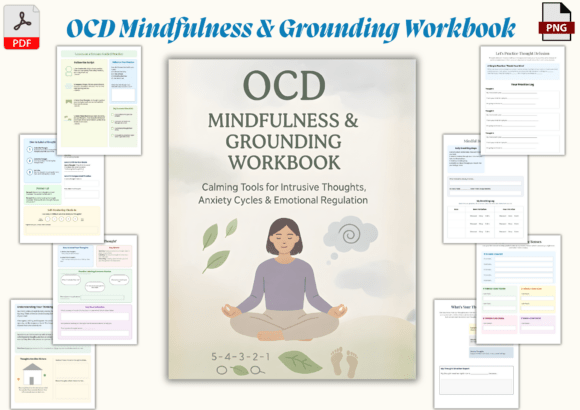
How the OCD Mindfulness Grounding Workbook Supports Emotional Resilience for All Ages
Living with obsessive-compulsive disorder (OCD) often means navigating relentless mental loops—repetitive, intrusive thoughts followed by rising anxiety and an urgent pull toward compulsive behaviors. While evidence-based treatments like Cognitive Behavioral Therapy (CBT) and Exposure and Response Prevention (ERP) remain clinical cornerstones, growing research highlights a powerful complementary tool: mindfulness-based grounding. Enter the OCD Mindfulness Grounding Workbook—a thoughtfully designed, printable resource that brings science-backed strategies into daily life in an accessible, compassionate, and visually soothing way.
What Is Mindfulness Grounding—and Why Does It Matter for OCD?
Mindfulness grounding is the intentional practice of anchoring attention to the present moment using sensory awareness, breath, body cues, or gentle movement. Unlike trying to “think your way out” of distress, grounding works by shifting neural focus away from threat-driven rumination and toward immediate, nonjudgmental experience. For individuals with OCD, this isn’t about suppressing intrusive thoughts—it’s about changing one’s relationship to them.
Neuroscience supports this approach: studies show regular mindfulness practice strengthens the prefrontal cortex (responsible for regulation) while calming hyperactivity in the amygdala (the brain’s fear center). Grounding interrupts the automatic thought–anxiety–compulsion cycle *in real time*, offering a pause where choice becomes possible again.
More Than Just “Calm Coloring”: The Purpose Behind the Workbook
The OCD Mindfulness Grounding Workbook isn’t a generic relaxation guide. Every page reflects intentional design grounded in clinical insight and developmental psychology. Measuring 8.5 x 11 inches and delivered as a high-resolution PDF/PNG, it’s optimized for clarity, ease of printing, and tactile engagement—whether used on paper or digitally with annotation tools.
Its purpose is threefold:
- Interrupt: Short, structured exercises help users notice rising anxiety early—before it escalates into full-blown distress or ritualizing.
- Anchor: Sensory-based grounding scripts (e.g., “5-4-3-2-1,” temperature tracking, breath pacing) recenter attention safely in the body and environment.
- Empower: Journaling prompts and self-soothing worksheets build metacognitive awareness—helping users recognize patterns, honor emotional needs, and reinforce agency over time.
This makes the workbook uniquely valuable not only for self-use but also across settings: therapists integrating adjunct tools into sessions, teachers supporting neurodiverse students, parents guiding anxious children, and homeschooling families prioritizing social-emotional learning.
Who Benefits—and How It Fits Into Real Life
Designed for children, teens, and adults, the workbook meets users where they are—literally and developmentally. Its soft-color illustrations, uncluttered layouts, and minimal text reduce cognitive load, making it inclusive for those with ADHD, learning differences, or language processing challenges. A teen overwhelmed before a test might use the “Breath & Body Scan” worksheet; a child recovering from a meltdown could trace the “Grounding Path” visual; an adult managing workplace anxiety might revisit the “Thought Labeling” journal prompt (“Is this thought helpful? True? Urgent?”).
In education, it supports trauma-informed classrooms by giving students concrete, nonverbal tools to self-regulate—reducing disruptions and fostering psychological safety. In therapy, clinicians report clients arrive more prepared for ERP work when they’ve already practiced noticing urges without acting. At home, caregivers gain shared language and routines—not “fixing” but attuning.
Debunking Common Misconceptions About OCD and Mindfulness
Several myths persist—misunderstandings that can delay support or deepen shame:
- “Mindfulness means stopping thoughts.” False. Mindfulness teaches observation—not elimination. The workbook normalizes intrusive thoughts as passing mental events, not truths or commands.
- “OCD is just about cleanliness or order.” Oversimplified. OCD manifests in many forms: harm-related fears, symmetry obsessions, religious scrupulosity, or existential doubts. This workbook addresses the underlying mechanism—uncertainty intolerance—not just surface themes.
- “If you’re ‘trying hard enough,’ you’ll outgrow it.” Harmful and inaccurate. OCD is a neurobiological condition. Consistent, compassionate practice—not willpower—is what rewires response patterns. The workbook honors effort, not perfection.
Crucially, this resource does not replace professional care. It complements it—offering practical, low-barrier entry points between sessions or during waitlists for specialized treatment.
Science Meets Simplicity: What’s Inside the Workbook
Each activity is rooted in empirically supported frameworks—including Acceptance and Commitment Therapy (ACT), Sensorimotor Psychotherapy, and Polyvagal Theory—but translated into everyday language and action. Key sections include:
Mindfulness Techniques That Ease Intrusive Thoughts
Guided audio scripts (included as printable cue cards) teach “thought surfing”—observing mental content like clouds drifting across a sky. Visual metaphors (e.g., “The Thought Train”) help externalize and depersonalize obsessions.
Grounding Exercises Using Senses, Breath, and Body Cues
From “Temperature Tapping” (holding an ice cube while naming textures) to “Feet-on-Floor Breathing,” these require no special equipment—just presence. They’re especially effective during dissociation or panic spikes.
Journaling Prompts to Slow Mental Loops
Rather than open-ended questions, prompts are targeted: “What sensation showed up first—the thought, the tightness, or the urge?” This cultivates interoceptive awareness—the ability to read internal signals—a skill strongly linked to emotional regulation.
Calming Worksheets for Anxiety Spikes
One-page “Anxiety First-Aid” sheets offer step-by-step visuals for rapid de-escalation—ideal for school counselors, crisis teams, or personal emergency kits.
Body-Scan Scripts and Breathing Tools
Adapted for varying attention spans, these range from 60-second “Hand Breath” (inhale as you trace thumb, exhale down index finger) to 5-minute seated scans—building somatic literacy gradually.
Strategies for Breaking the Thought-Anxiety-Compulsion Cycle
A unique “Cycle Breaker Flowchart” helps users identify their personal triggers and interrupt points—turning abstract theory into personalized action.
Self-Soothing Practices to Build Emotional Resilience
Includes co-regulation ideas (e.g., “Shared Breath with a Trusted Person”) and solo practices like weighted blanket mapping or scent-based grounding—validating diverse nervous system needs.
Why Format Matters: The Power of Printability and Accessibility
Delivered as a ready-to-print 8.5 x 11 inch PDF/PNG, the workbook prioritizes usability. No login walls, subscriptions, or app dependencies. Users print single pages or entire sections—laminate favorites for repeated use, bind into journals, or project in group settings. High-resolution ensures crisp text and gentle illustrations retain clarity even when enlarged for visual impairments.
This accessibility aligns with modern digital wellness principles: reducing screen fatigue while supporting offline, embodied practice—a vital counterbalance in our hyperconnected world.
A Supportive Step Forward—Not a Quick Fix
The OCD Mindfulness Grounding Workbook doesn’t promise overnight transformation. Instead, it offers something equally vital: consistency, compassion, and concrete steps. Each completed page is evidence—not of “cure,” but of courage. Of showing up, again and again, with kindness toward a mind that’s been working overtime.
Whether you’re a therapist seeking fresh tools, a parent holding space for a struggling child, an educator nurturing whole-student growth, or someone quietly reclaiming calm in your own skin—this workbook meets you with quiet strength. It reminds us that healing isn’t always loud. Sometimes, it’s the soft color of a breathing guide, the steady rhythm of a traced hand, or the quiet certainty of feet on the floor.
Download the OCD Mindfulness Grounding Workbook today—and begin building resilience, one grounded breath at a time.