2026–2027 A Safe Space Journal KDP
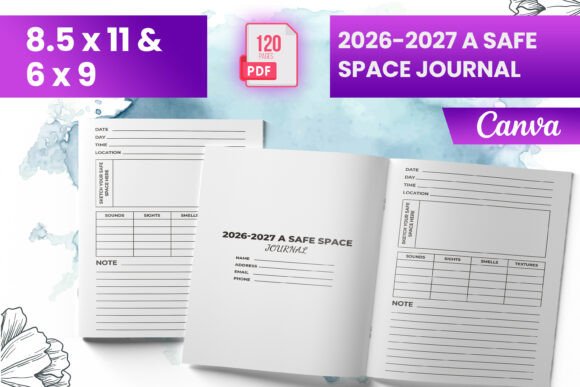
Imagine opening a journal that doesn’t ask you to perform, fix, or justify — just hold space. The 2026–2027 A Safe Space Journal KDP is designed for exactly that: quiet intention, emotional grounding, and self-trust. It’s not a planner with rigid deadlines or a productivity tool disguised as wellness. It’s a 120-page interior file built for Amazon KDP — tested, bleed-ready, and formatted across six standard trim sizes (6″ × 9″, 8.5″ × 11″, and more) so it prints cleanly, every time.
What makes this different from generic journal interiors? Every page supports psychological safety — gentle prompts, open-ended reflection zones, breathing space between sections, and no forced positivity. The design avoids visual clutter, uses accessible typography, and leaves room for handwriting, sketching, or collage. And because it arrives as a ready-to-upload PDF plus supporting PNG and JPG files, there’s no guesswork about margins, bleed, or KDP compatibility.
Why This Matters — Depending on Who You Are
Your relationship to a journal isn’t universal. A therapist might need structure that invites depth without pressure. A small business owner launching a mental wellness brand may prioritize clean, scalable formatting they can rebrand. A student managing anxiety might value simplicity over aesthetics. Here’s how the 2026–2027 A Safe Space Journal KDP meets those varied needs — without asking anyone to adapt themselves to the tool.
For Beginners Exploring Self-Reflection
If you’ve tried journaling before but stopped after a week, this interior removes common friction points: no “shoulds,” no complex instructions, and no expectation of daily consistency. The intro page gently explains how to use the journal — not as a task, but as an invitation. Pages include soft cues like “Pause here,” “No answer needed,” or “Draw what feels steady today.” That kind of scaffolding helps newcomers build confidence, not guilt.
For Educators & Counselors Building Resources
School counselors, trauma-informed teachers, or nonprofit program coordinators often create materials for groups with diverse emotional capacities. This journal interior works well in classroom settings or community workshops because it’s neutral in tone, inclusive in language, and adaptable across age ranges (with minor facilitation). You can print single pages for handouts, bind full copies for students, or use the PNG files to embed pages into digital learning platforms. Since it’s bleed-ready and KDP-tested, you know it will reproduce clearly — important when clarity supports accessibility.
For Creators Launching a Wellness Brand
If you’re building a small business around mental health, mindfulness, or recovery support, having a professionally formatted, production-ready interior saves dozens of hours. No need to hire a designer for basic layout or troubleshoot KDP warnings. The included files let you focus on your voice — adding your logo, adjusting cover copy, or bundling with guided audio or worksheets. Because the interior already includes thoughtful spacing and consistent typography, your brand feels intentional, not DIY.
For Freelancers & Marketers Managing Multiple Projects
Time is non-renewable. When you’re juggling client work, content creation, and personal projects, speed matters — but not at the cost of quality. With the 2026–2027 A Safe Space Journal KDP, you skip the trial-and-error phase. The files were validated on KDP, meaning no last-minute resizing, no rejected uploads, no surprise pixelation. You get predictable results, fast. That reliability means you can test a low-risk product launch alongside higher-stakes initiatives — say, while developing a course or writing a book.
What’s Inside — And Why Each Detail Serves a Purpose
This isn’t just “120 pages of blank lines.” Every component answers a real question creators and users face:
- Ready-to-upload PDF: No conversion errors, no font substitution, no broken links. Just upload and publish.
- Six trim sizes: Choose what fits your audience — compact for travel, large for art integration, standard for readability.
- Intro page: Sets compassionate context, not rules. Helps readers feel welcomed, not assessed.
- PNG + JPG files: Useful for social previews, website mockups, or Canva-based marketing assets — no extra design work required.
- Bleed-ready interior: Ensures background colors or subtle textures extend fully to the edge — critical for professional appearance.
None of these features exist in isolation. For example, the bleed setting matters most if you plan to use soft watercolor-style backgrounds — something educators or artists might appreciate. The multiple trim sizes matter most if you’re testing which format resonates with your audience before committing to inventory. And the tested KDP compatibility? That’s vital if you’ve ever lost a week to troubleshooting margin warnings.
How to Know If This Fits Your Goals
Ask yourself:
- Do you want to offer a tangible, reflective tool — not another digital app or PDF download? Then a physical journal via KDP makes sense. This interior lets you do that without layout expertise.
- Are you prioritizing emotional resonance over decorative complexity? This interior leans into calm, not clutter — minimal borders, generous line spacing, and intentional white space.
- Is consistency across formats important to you? Whether someone orders a 6×9 paperback or an 8.5×11 spiral-bound version, the experience remains cohesive — because the same thoughtful structure scales across sizes.
- Do you value flexibility in how you use the file? You can sell it as-is, layer your branding on top, adapt prompts for specific communities (e.g., caregivers, neurodivergent adults), or even split it into smaller themed workbooks.
It’s not for everyone — and that’s by design. If you need highly illustrated spreads, interactive checkboxes, or embedded QR codes linking to videos, this interior won’t match that vision. But if your aim is grounded, human-centered reflection — delivered with care and technical precision — then the 2026–2027 A Safe Space Journal KDP aligns closely with that intention.
Whether you're showing up for yourself, your students, your clients, or your audience — the goal isn’t perfection. It’s presence. And sometimes, the simplest thing you can offer is space that holds people exactly as they are.