Interior Design Project Planner: A Practical Framework for Coordinating Every Phase of a Design Build
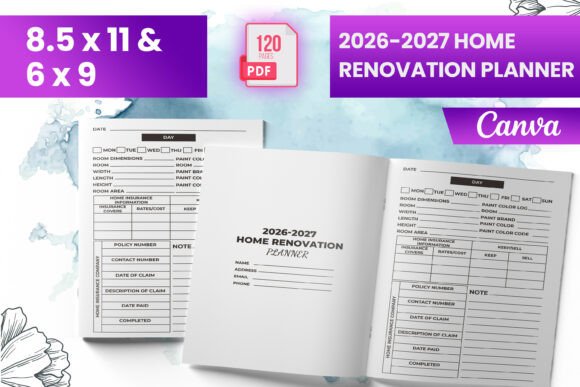
Managing an interior design project—whether it’s a full home renovation, a boutique commercial space, or a single-room refresh—requires more than inspiration and aesthetics. It demands structure: clear documentation, consistent communication, budget discipline, and phased execution. The Interior Design Project Planner is not just another printable workbook—it’s a rigorously tested operational system built to align creative vision with logistical reality. Designed specifically for real-world use, its 120-page architecture reflects how professionals actually work—not how theoretical models suggest they should.
How the Planner Mirrors Real-World Workflow
Unlike generic planners that impose arbitrary sections, this Interior Design Project Planner maps directly to the cadence of a live project. Its sequence begins before measurements are taken and extends past final installation—capturing decision points most tools overlook. For example, the Client Details section spans six pages—not just contact fields, but dedicated space for lifestyle notes, accessibility requirements, pet considerations, storage pain points, and even preferred maintenance thresholds (e.g., “low-dust finishes only”). These granular inputs shape material selections later in the Furniture Decor Planner and Room Planning sections.
The Project Overview pages don’t ask for vague goals like “make it cozy.” Instead, they prompt users to define measurable success criteria: “Reduce morning clutter by relocating laundry to mudroom,” “Ensure all primary living zones support screen-free interaction,” or “Achieve LEED Silver-compliant finish specifications.” Such specificity prevents scope creep and anchors revisions in functional outcomes—not subjective impressions.
Mood Board & Inspiration: Beyond Pinterest Clutter
The 14-page Mood board Inspiration section moves beyond collage-making into analytical curation. Each page includes labeled quadrants: Color Palette Reference, Texture Swatch Log, Scale & Proportion Notes, and Contextual Constraints (e.g., “North-facing light reduces saturation by ~15%—adjust paint LRV accordingly”). This transforms mood boards from aspirational artifacts into diagnostic tools. Designers using this planner report fewer client revisions at the specification stage because visual intent is translated early into quantifiable parameters.
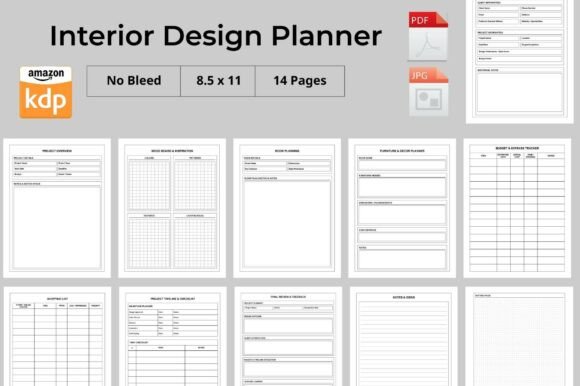
High-resolution JPG and PDF files—300 dpi, 8.5″ x 11″, no bleed—are optimized for both digital annotation and physical printing. When printed, the crispness preserves fabric weave detail and paint sheen gradients; when used digitally, layers remain legible on tablets during site walkthroughs. This dual-mode readiness supports hybrid workflows common among architects, stylists, and DIY renovators alike.
Room Planning and Spatial Logic
The 20-page Room Planning section treats space as a dynamic system—not static geometry. Pages include annotated floor plan grids (with adjustable scale markers), adjacency matrices (“Which zones must be visually connected? Which require acoustic separation?”), circulation path overlays, and daylight analysis prompts. One page asks users to sketch three distinct furniture layouts—not just one “ideal” version—but to evaluate each against specific metrics: walking distance between sofa and coffee table (<36”), sightlines to entryways, and natural light coverage at 9 a.m. and 3 p.m.
This approach surfaces trade-offs early. A layout maximizing open sightlines may compromise storage capacity. Another prioritizing acoustics might reduce natural ventilation flow. Documenting these tensions explicitly helps clients understand why certain compromises exist—and builds trust through transparency.
From Selection to Sourcing: Furniture, Finishes, and Accountability
The Furniture Decor Planner (16 pages) integrates aesthetic, ergonomic, and procurement intelligence. Each item entry includes fields for: dimensions (with tolerance notes), lead time, assembly complexity rating (1–5), sustainability certifications (FSC, Greenguard, OEKO-TEX), and delivery constraints (e.g., “stair-only access—max width 22″”). This level of detail supports accurate contractor coordination and avoids last-minute substitutions that derail timelines.
Similarly, the Budget Expense Tracker (12 pages) avoids simple line-item lists. It groups costs by phase (pre-construction, demolition, framing, finishes), tracks contingency allocation (automatically calculating remaining buffer %), and flags high-variance categories—like custom millwork or imported tile—where estimates often shift post-bid. Users record not just quoted amounts, but the source (contractor A vs. supplier B), date captured, and assumptions made (“quoted excluding grout color matching”).
Operational Rigor Meets Creative Flexibility
The Shopping List (10 pages) and Project Timeline Checklist (10 pages) function as synchronized control centers. The shopping list auto-categorizes by vendor type (lighting, plumbing, textiles) and tags items with dependencies (“Order pendant lights *after* ceiling electrical rough-in is signed off”). The timeline checklist uses color-coded status markers (planned / ordered / received / installed / inspected) and includes buffer days pre-scheduled—not added reactively—based on historical delay patterns (e.g., “+3 days after drywall mud application due to humidity-dependent curing”).
Crucially, the Final Review Feedback section (5 pages) doesn’t just collect client signatures. It structures reflection: “What three decisions accelerated progress?” “Which two assumptions proved inaccurate—and why?” “What would you change about the information handoff process?” These questions turn completed projects into institutional knowledge—valuable for freelancers building portfolios, educators developing curricula, or small firms refining SOPs.
Why Print-Ready Precision Matters
The technical specifications—PDF Files ready to print, 300 dpi resolution, 8.5″ x 11″ size, No Bleed, Perfect Interior size for KDP—are not arbitrary. They reflect hard-won lessons from over 100 Amazon KDP uploads. Bleed-free design prevents critical margins from being cropped during automated binding. The precise trim size ensures alignment with standard spiral-bound notebooks and KDP’s paperback templates. High-resolution JPGs allow designers to extract individual mood board pages for client presentations without pixelation—even when projected at 120″ diagonal.
This attention to production detail benefits diverse users: educators print class sets for hands-on studio exercises; contractors annotate physical copies onsite where tablets fail; researchers studying design decision-making use the standardized format for cross-case analysis; and hobbyists appreciate that dotted pages (10 included) provide flexible sketch space without rigid lines interfering with freehand layout studies.
Customization Without Compromise
“Customizable Pages” does not mean blank templates. It means intentional scaffolding: editable text fields in PDFs (compatible with Adobe Acrobat and Preview), placeholder icons that can be replaced with actual product images, and modular sections that can be reordered or omitted without breaking the document’s internal logic. A stylist working on a rental refresh might skip the Blueprint Layout pages but expand the Notes Ideas section to track landlord approval pathways. An architect integrating interior specs into a larger BIM workflow might extract only the Materials and Finish logs for direct import into Revit schedules.
The Notes Ideas (10 pages) and Dotted Pages (10 pages) serve distinct roles: the former captures contextual observations (“Client hesitated when shown matte black fixtures—note preference for warm metallics”), while the latter supports rapid ideation—sketching alternate layouts, testing color combinations, or diagramming spatial relationships. This separation prevents brainstorming from contaminating structured documentation.
Who Benefits—and How
Professionals gain audit-ready records for insurance claims, client disputes, or licensing board reviews. The Contractor Estimates log ensures verbal agreements are memorialized with dates and participants.
Consumers avoid costly miscommunications. Recording paint samples alongside actual wall photos (taken under morning and evening light) prevents “why does this look nothing like the swatch?” moments.
Educators use the planner as a teaching scaffold—assigning students to complete specific sections as part of studio critiques, then comparing approaches across peer groups.
DIY renovators benefit from embedded guardrails: the Renovation Safety Notes page prompts asbestos testing verification, load-bearing wall checks, and permit tracking—all integrated into the main flow rather than buried in appendices.
Researchers studying design cognition find value in the planner’s constraint-based prompts. Unlike open-ended journals, its questions reveal how practitioners encode uncertainty, manage ambiguity, and translate qualitative preferences into quantitative specifications.
Not Just a Tool—A Discipline
The Interior Design Project Planner succeeds because it respects the complexity of its domain. It doesn’t promise to “simplify” design—it provides infrastructure for managing its inherent intricacy. Its strength lies in what it refuses to do: oversimplify budgets into totals, reduce inspiration to images, or treat timelines as linear sequences. Instead, it honors the iterative, interdependent, and deeply human nature of shaping space.
Whether guiding a first-time homeowner through their kitchen remodel, supporting a stylist launching a new service offering, or helping a university department standardize capstone project documentation, this planner operates at the intersection of craft and clarity. It’s not about doing more—it’s about doing what matters, deliberately, and leaving evidence of why.