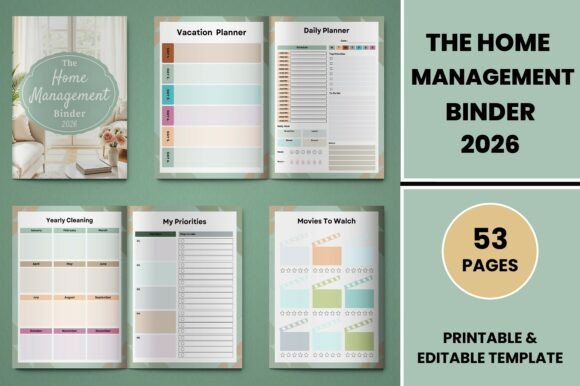
The Home Management Binder 2026
Running a home shouldn’t feel like managing a startup—yet for many adults juggling careers, caregiving, creative projects, or side hustles, it often does. The The Home Management Binder 2026 steps in not as another to-do list, but as a grounded, intentional system designed for real life—not perfection. It’s built for people who want clarity without clutter: freelancers tracking income while meal prepping on Sundays, educators organizing family logistics between school terms, small business owners balancing client deadlines and household maintenance, or new parents seeking rhythm amid chaos. Its pastel layouts and thoughtful structure aren’t just aesthetically soothing—they’re functional cues that reduce cognitive load and support consistency.
Common Missteps—and Why They Matter
Many people download or purchase The Home Management Binder 2026 with high hopes—only to find it gathering dust by March. That’s rarely about the binder itself. More often, it’s about how it’s approached. Let’s clarify what trips people up—and how to sidestep those pitfalls.
Assuming “All-in-One” Means “Use Everything”
One of the most frequent oversights is treating every section as mandatory. Pages like the Garden Equipment List or Travel Packing Checklists are valuable—but only if they match your current season of life. A city-dwelling freelancer with no garden won’t benefit from page 35 until they move—or start container gardening. Using irrelevant sections creates friction, not flow. Instead, start with just three tools you’ll use weekly: the Weekly Cleaning Schedule, the Meal Planner (page 16), and the Daily Priorities & Water Tracker (page 39). Add others gradually—like the Wheel of Life Goal Tracker (page 46)—only when you notice recurring gaps in balance or focus.
Skipping the Setup Step—Especially the Calendar Overview
Page 3—the 2026 Calendar Overview—isn’t just decorative. It’s your strategic anchor. Skipping it means missing key opportunities: aligning budget reviews with pay cycles, scheduling HVAC maintenance before seasonal shifts, or blocking time for quarterly goal reflection. One educator we spoke with waited until mid-January to flip to this page—then realized she’d missed adding her school’s professional development days, causing last-minute schedule conflicts. Take 20 minutes upfront: highlight fixed dates (tax deadlines, birthdays, insurance renewals), color-code recurring commitments, and note one personal milestone per month. This turns passive planning into proactive stewardship.
Mistaking Print-Ready Files for Plug-and-Play Systems
The Home Management Binder 2026 arrives as printable PDFs—not a physical binder. That flexibility is powerful, but it requires intention. Some users print everything double-sided, then realize the Monthly Meal Calendar (page 20) needs writing space, or the Habit Tracker (page 22) works best with a fine-tip pen—not a ballpoint that bleeds. Before printing, scan pages for interactive elements: checklists with checkboxes, trackers with blank rows, or logs meant for quick notes. Print those on thicker paper or use a notebook insert system. For digital-first users, consider using GoodNotes or Notability with the PDF—many find the Mood Tracker (page 40) more sustainable when tapped than scribbled.
Overlooking the “Why” Behind the Layout
The calming pastel design isn’t just branding—it supports usability. Soft blues and sage greens reduce visual fatigue during daily review; clear iconography (like the leaf for garden tasks or water droplet for hydration) lets your brain parse information faster. But that only works if you engage with the design intentionally. One small business owner admitted she’d blacked out all the icons with marker “to make it look serious.” She later realized she’d lost her fastest visual cue for scanning chores. Keep the icons visible. Use them as mental shortcuts—not decorations to override.
What to Check Before You Commit
Before downloading or purchasing The Home Management Binder 2026, ask yourself these practical questions:
- Do I prefer analog or hybrid use? If you rely heavily on digital calendars or apps, confirm whether the binder’s structure complements—not competes—with your existing tools. The Daily Weekly Planner (pages 39–40) pairs well with Google Calendar reminders, for example—but only if you review both daily.
- What’s my biggest household pain point right now? Is it forgotten appointments? Food waste? Unplanned repair costs? Match that need to a specific section: Family Information Log for contact chaos, Annual Maintenance Templates (pages 26–27) for surprise bills, or Meal Ideas + Planner (pages 16, 20–21) for reducing takeout spend.
- Do I have 10 minutes a week to maintain it? Sustainability hinges on maintenance—not setup. If weekly review feels unrealistic, start with biweekly. Use the Priority List Wheel of Life (page 47) to identify which area deserves attention first—then protect that slot like a client meeting.
Better Than “Getting Organized”—Building Capacity
What makes The Home Management Binder 2026 different isn’t its completeness—it’s its coherence. Each section connects: your Weekly Cleaning Schedule informs your Annual Maintenance Log; your Meal Planner reduces grocery overbuying, freeing budget space for home upgrades tracked in the same binder. It’s not about doing more—it’s about making each action count toward stability, not just speed.
One freelance writer used the Goal Tracker (page 23) to break down “launch a course” into monthly home-based actions: research tools (January), draft outline (February), film first module (March)—all synced with her Hourly Daily Schedule (page 39). No extra apps. No fragmented notes. Just one place where professional ambition and household rhythm coexist.
That’s the quiet power of The Home Management Binder 2026: it doesn’t ask you to become someone else. It supports who you already are—capable, caring, and constantly adapting—while quietly removing the friction that makes home management feel overwhelming. Start small. Stay consistent. Let the structure hold space for what matters—not just what’s urgent.