2026–2027 ADHD Planner for Kids KDP
For creators, educators, and small publishers building resources for neurodiverse learners, the 2026–2027 ADHD Planner for Kids KDP stands out as a purpose-built interior file designed specifically for Amazon’s Kindle Direct Publishing platform. It’s not a generic printable or a broad-spectrum planner — it’s a tested, production-ready asset focused on supporting children with ADHD through structure, visual clarity, and consistent routines across the 2026–2027 academic year.
What This Planner Actually Delivers — Beyond the Listing
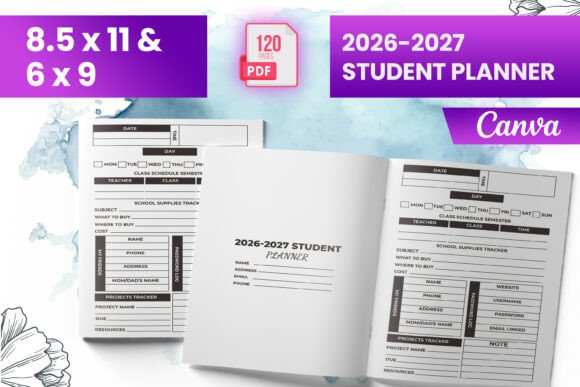
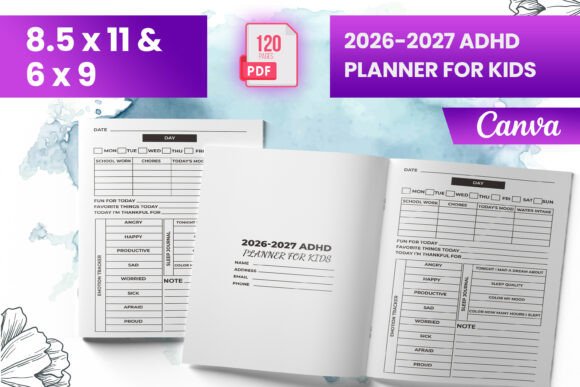
The 2026–2027 ADHD Planner for Kids KDP includes a complete 120-page interior PDF file optimized for print-on-demand publishing. That number reflects intentional pacing: enough space for weekly planning, habit tracking, emotion check-ins, goal setting, and reflection — but not so much that pages feel overwhelming or underutilized. The layout balances white space with functional prompts, using clear typography, consistent iconography, and minimal visual clutter — all calibrated to reduce cognitive load for kids who benefit from predictable, low-stimulus design.
It ships in six standard trim sizes: 6″ × 9″, 8.5″ × 11″, and their metric equivalents (A4, A5, etc.), allowing flexibility depending on target age group and binding preference. Younger children may respond better to larger formats with more room for drawing or stickers; older elementary students often prefer compact, portable options. All versions include bleed — meaning artwork and backgrounds extend slightly beyond the trim edge — ensuring no unintended white borders appear after KDP’s automated cropping.
Why “Tested on KDP” Matters Practically
Many planners list “KDP-ready” as a feature without verification. In contrast, the 2026–2027 ADHD Planner for Kids KDP has been validated through actual upload and preview cycles on Amazon’s system. That means margins meet KDP’s minimum requirements, fonts are embedded correctly, color profiles avoid unexpected shifts, and page numbering aligns with spine calculations for perfect-bound books. You won’t need to troubleshoot bleed errors, gutter misalignment, or thumbnail rendering issues mid-launch.
Included PNG and JPG files serve dual purposes: they’re useful for marketing visuals (e.g., Amazon book previews, social media banners) and for customizing covers or supplementary materials in Canva. Since the interior is provided as a single, flattened PDF, users aren’t required to manage layered design files — reducing friction for those without Adobe Illustrator or InDesign experience. That makes the 2026–2027 ADHD Planner for Kids KDP especially viable for solopreneurs, teachers launching side projects, or content creators prioritizing speed-to-market over deep customization.
Real-World Usability for Children and Caregivers
ADHD-friendly planning isn’t about rigid scheduling — it’s about scaffolding executive function skills. The 2026–2027 ADHD Planner for Kids KDP incorporates evidence-informed elements: time-blindness accommodations (e.g., visual timers mapped to daily blocks), transition prompts between activities, self-regulation cues (like “How am I feeling right now?” with emoji-based scales), and reward-based habit trackers that emphasize consistency over perfection.
Teachers report success using similar structures during morning meetings or executive function coaching sessions. Parents appreciate having a physical tool that doesn’t compete with screen time yet still supports accountability — especially when paired with verbal check-ins or co-planning. One educator noted using the weekly overview spread to break down long-term assignments into manageable chunks, then referencing the same page daily to reinforce sequencing and task initiation.
Who Benefits Most — And Where It Fits in a Broader Workflow
This planner works best when integrated into a defined support strategy — not as a standalone fix. Its strongest use cases include:
- Educators and school counselors creating supplemental tools for IEP or 504 plan implementation;
- KDP publishers expanding niche offerings in neurodiversity-aligned educational resources;
- Occupational therapists and behavioral coaches who want reproducible, non-clinical handouts for home practice;
- Parent-led microbusinesses selling printed planners alongside workshops or digital courses on ADHD parenting;
- Canva-based creators who need a polished interior foundation before adding branded covers, worksheets, or companion guides.
It’s less suited for users needing heavy interactivity (e.g., editable fields, hyperlinked navigation) or extensive personalization (e.g., swapping out entire sections, integrating external data). The interior is static — intentional for print reliability, but limiting if your audience expects digital adaptability.
Design Consistency and Long-Term Value
Every spread follows the same underlying grid system and typographic hierarchy. That consistency reduces learning curves: once a child understands how to use Monday’s page, Tuesday’s feels familiar — critical for maintaining engagement across weeks and months. Color use is restrained and functional (not decorative), with high-contrast text and clearly differentiated zones for tasks, notes, and reflections.
Because it spans the full 2026–2027 school year — including summer bridge weeks and flexible start/end dates — it avoids the common pitfall of mid-year obsolescence. Unlike calendar-based planners tied to fixed dates, this version uses relative week numbering and blank date fields, letting users begin anytime while preserving seasonal relevance (e.g., back-to-school prep, holiday breaks, end-of-year review).
Practical Considerations Before You Use It
If you’re evaluating the 2026–2027 ADHD Planner for Kids KDP for your own project, consider these points:
- Cover design responsibility remains yours. While interior files are included, KDP requires a separate, properly formatted cover file — ideally matching the interior’s tone and accessibility standards.
- Age appropriateness varies by implementation. The layout supports ages 6–12, but younger users may need adult guidance for writing or interpreting prompts. Older kids might benefit from pairing it with journaling extensions or goal-setting add-ons.
- Localization requires manual effort. The interior uses English-language prompts and U.S.-style date formatting. Adapting for other regions or languages means editing the PDF or rebuilding spreads — something the current file set doesn’t support natively.
- It’s an interior-only asset. No editable source files (e.g., .indd or .psd) are included, so structural changes — like reordering sections or altering font families — aren’t feasible without redesign work.
That said, its readiness for immediate upload significantly shortens time-to-publication. For someone managing multiple KDP titles or launching a themed bundle (e.g., “ADHD Support Kit for Kids”), having one verified interior eliminates days of trial-and-error testing.
Final Assessment: A Focused, Production-Ready Tool
The 2026–2027 ADHD Planner for Kids KDP fills a specific, well-defined gap: it’s a professionally structured, academically aligned, and technically compliant interior file built for creators who understand both the needs of neurodiverse children and the constraints of print-on-demand publishing. It doesn’t try to be everything — no curriculum integration, no audio components, no AI features — and that focus is its strength. When used intentionally — paired with caregiver involvement, classroom reinforcement, or thoughtful branding — it becomes a reliable component in a broader support ecosystem. For publishers prioritizing quality control, speed, and functional design over novelty, it’s a pragmatic, field-tested choice.