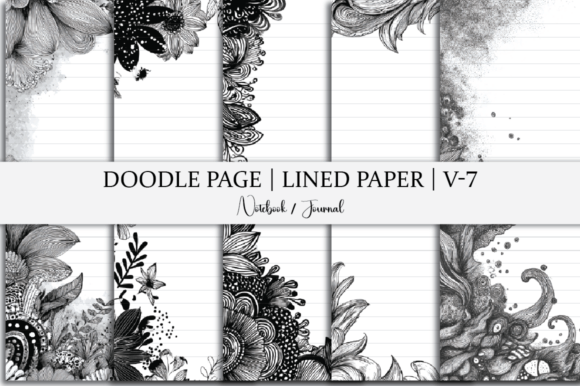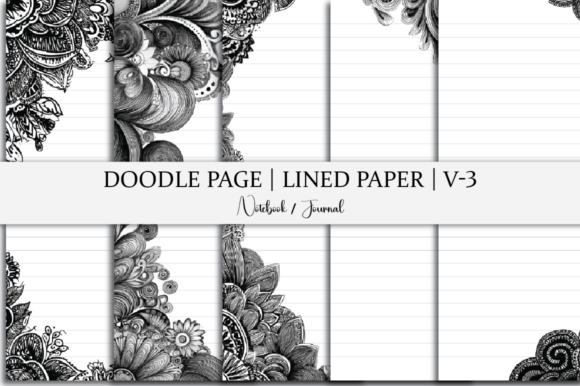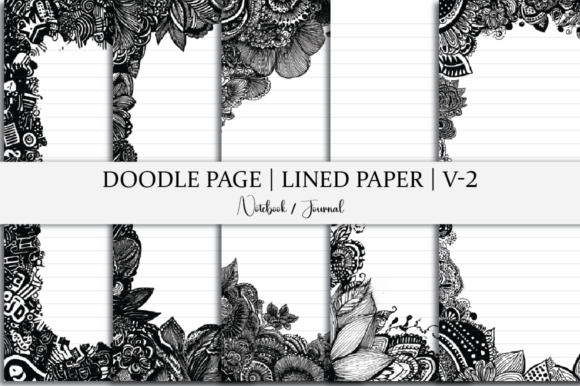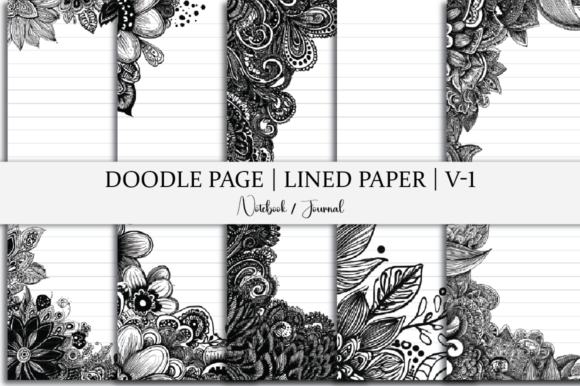
Doodle Page Lined Paper Notebook
If you’ve ever jotted down a sudden idea on a napkin, scribbled meeting notes in the margin of a printed report, or found yourself flipping through a half-filled notebook searching for that one perfect sketch—then the Doodle Page Lined Paper Notebook is built for moments like those. It’s not just another printable—it’s a flexible, tactile-feeling digital tool designed to meet the messy, joyful, unpredictable rhythm of real-life thinking.
What It Really Is (and Why That Matters)
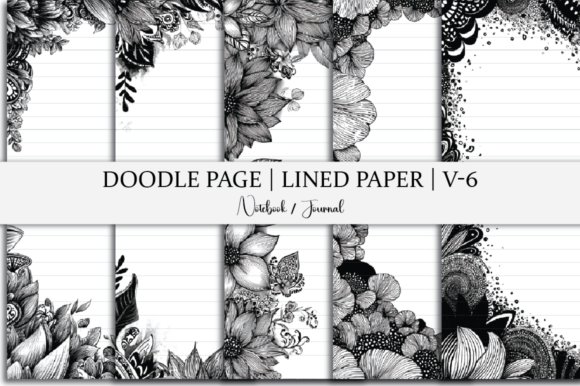
At its core, the Doodle Page Lined Paper Notebook is a set of five clean, versatile, 6 x 9 inch lined pages—delivered instantly as a downloadable zip file containing JPG, PNG, SVG, PDF, and source files. There’s no physical product, no shipping delay, no waiting. You click, pay, and download—all in under a minute.
But what makes it different from any other lined printable? It’s in the balance: the lines are subtle enough to support handwriting without boxing in creativity, and the layout leaves generous white space—ideal for side notes, quick sketches, arrows connecting thoughts, or even small doodles beside a to-do list. It’s lined paper with breathing room.
Where It Fits Into Real Life (Not Just “Productivity”)
People don’t reach for notebooks during calm, scheduled moments—they grab them when things get interesting. Here’s where the Doodle Page Lined Paper Notebook quietly becomes indispensable:
- Freelancers managing client calls: Print one page before each Zoom session. Jot down action items on the lines—and sketch a quick flowchart or timeline in the margins. Later, scan and file it with your project folder. The 6 x 9 size fits neatly into most desk organizers or tablet sleeves.
- Teachers planning lessons on the fly: Use the PDF version in a note-taking app like GoodNotes or Notability. Type a warm-up question at the top, handwrite student responses in the lines below, and circle key misconceptions with a stylus—no need to switch apps or lose momentum.
- Writers drafting dialogue or scene notes: The lined format supports natural sentence flow, while the blank space invites character sketches, setting notes, or emotional tone reminders—like “voice tired here” or “pause after this line.”
- Therapists and coaches: Some clinicians use printed pages as part of reflective exercises—clients write responses on the lines, then circle or underline words that carry weight. The consistent structure provides gentle scaffolding without feeling clinical or rigid.
- Small business owners tracking inventory or service requests: Print a fresh page weekly. List items or jobs on the lines, then add checkmarks, initials, or quick status icons (✔️, ⏳, 📦) in the margins—no complex software required.
Who Benefits Most—and How Their Needs Shape the Use
A graphic designer might open the SVG file in Illustrator, adjust line spacing to match their brand guidelines, and drop the page into a client presentation deck as a “handwritten brainstorming” slide. A high school science teacher may print ten copies, hole-punch them, and bind them into a reusable lab journal—students write hypotheses on the lines and sketch diagrams beside them. A parent organizing summer camp sign-ups could paste the JPG version into Canva, add headers and checkboxes, and email it as a shared family checklist.
The flexibility comes from the file variety—not because you need all five formats at once, but because life rarely asks for just one. Need to edit text? Use the source file. Want crisp printing? Go with PDF. Planning to layer it over a photo background in Photoshop? Grab the PNG with transparent background. That range means the Doodle Page Lined Paper Notebook adapts to your workflow—not the other way around.
Things to Keep in Mind Before You Download
Because it’s digital-only, this notebook won’t replace the feel of a favorite Moleskine—but it will replace the frustration of running out of pages mid-project or needing a specific size for binding. If you rely heavily on handwritten archives, consider how you’ll organize these pages long-term: will you print and file them? Import into a digital note system? Use them as temporary scratch space before transferring key ideas elsewhere?
Also worth noting: the lined layout assumes standard handwriting scale. If you write very large or very small, you may want to test-print one page first—most printers allow scaling adjustments, and the PDF version opens cleanly in preview tools where you can zoom or reflow as needed.
And while the design is intentionally minimal (no logos, no watermarks, no forced branding), that also means it doesn’t include extras like page numbers, section dividers, or cover art. That’s by design—it stays neutral so you decide how and where it fits.
Strengths That Show Up in Practice
The biggest strength isn’t technical—it’s psychological. Knowing you have five clean, consistent, ready-to-go lined pages lowers the barrier to starting. No scrolling through templates. No debating fonts or margins. Just open, print, write. That small reduction in friction adds up: one user reported using it for daily gratitude journaling after realizing they’d abandoned three apps because “opening the app felt like a chore.” With this, she printed a stack, kept them clipped together, and wrote every morning before checking her phone.
Another quiet advantage? Consistency across devices. Whether you’re reviewing notes on your iPad, projecting them in a team huddle, or printing a hard copy for a workshop handout—the lines stay crisp, the spacing stays readable, and the 6 x 9 ratio fits comfortably in most hands and scanners.
When It Might Not Be the Best Fit
If you need deeply structured templates—like budget trackers with formulas, habit streak calendars, or legal intake forms—this isn’t the tool. It’s lined paper, not a spreadsheet. Likewise, if you prefer wide-ruled or graph paper for technical sketches or music notation, the standard line spacing may feel too tight.
And while the instant download is a huge plus for urgency, it does mean no customer support for printing issues or file compatibility—though the inclusion of multiple formats (JPG, PNG, SVG, PDF, source) covers nearly every common use case across operating systems and apps.
A Small Tool With Unexpected Reach
One illustrator told us she uses the Doodle Page Lined Paper Notebook to draft client feedback. She prints a page, writes her notes in blue pen, scans it, and emails it back with a personal touch—“feels warmer than bullet points in a Slack message,” she said. Another user—a nurse transitioning into health coaching—uses the PDF version to map out client wellness goals: lines for short-term actions, margins for motivational quotes or symptom trackers she adds by hand.
It’s not flashy. It doesn’t promise transformation. But in the spaces between big goals—where ideas spark, plans take shape, and clarity emerges line by line—that’s exactly where the Doodle Page Lined Paper Notebook earns its place.