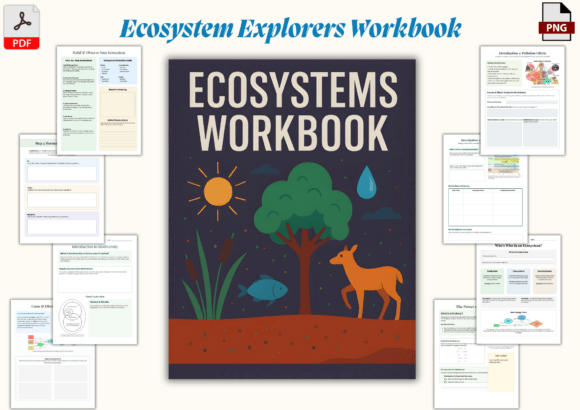
Ecosystems Workbook: Make Science Stick
Teaching ecosystems shouldn’t mean translating textbook jargon into student confusion. Nor should it mean spending evenings designing diagrams from scratch or piecing together fragmented online worksheets that lack coherence. The Ecosystems Workbook bridges that gap—not with flash or gimmicks, but with thoughtful design grounded in how upper elementary and middle school learners actually build scientific understanding.
Clarity Where Complexity Usually Takes Over
Food chains versus food webs. Trophic levels versus energy transfer. Producers, primary consumers, decomposers—terms that sound precise on paper but blur together without context. The Ecosystems Workbook tackles this head-on by anchoring each concept in visual scaffolding: layered food web diagrams with color-coded roles, annotated energy pyramids showing 10% transfer loss, and side-by-side comparisons that highlight *why* a web is more realistic than a linear chain. One Grade 5 teacher reported her students independently corrected a common misconception—that “decomposers eat everything”—after completing the guided soil microhabitat observation page. That kind of durable understanding doesn’t come from repetition alone; it comes from structured inquiry paired with immediate, tangible representation.
Time-Saving Without Sacrificing Depth
For educators juggling lesson planning, differentiation, and assessment, the Ecosystems Workbook functions as a ready-to-deploy unit backbone—not an add-on. Its 8.5 x 11 inch layout fits standard binders and printer trays, and the PDF+PNG format means no formatting surprises when opened across devices. A STEM coordinator in Oregon uses the cause-effect investigation pages during station rotations: students analyze real-world disruptions (e.g., invasive zebra mussels in the Great Lakes) using provided data snippets and structured prompts, then draft evidence-based predictions. She reuses the same pages year after year—editing text boxes for new examples, printing only what’s needed, skipping prep for three full class periods each cycle.
Supporting Diverse Learning Pathways
Homeschooling parents appreciate how the workbook meets kids where they are. One parent shared how her auditory learner thrived using the illustrated guides to narrate food web relationships aloud, while her kinesthetic child built physical models using the included cut-and-paste species cards. The reflection tasks—short written responses, sketch-to-explain prompts, and “What if?” scenarios—are open-ended enough to invite creativity but scaffolded enough to prevent overwhelm. There’s no single “right” diagram for the forest food web challenge; instead, students justify their placements using evidence from prior pages—practicing argumentation long before formal science writing begins.
Real-World Anchors, Not Just Abstractions
Abstract ecology concepts gain meaning when tied to observable phenomena. The Ecosystems Workbook embeds local relevance: a pond ecosystem observation chart includes space for recording actual pH, temperature, and visible organisms (with photo references); a biodiversity tally page encourages backyard or park surveys; and the energy transfer analysis pages use familiar examples—like how many blades of grass support one grasshopper, which supports one frog—before scaling up to regional systems. This grounds learning in place and experience, making conservation discussions feel personal rather than distant.
What It Does Well—and Where to Supplement
The Ecosystems Workbook excels at building foundational systems thinking: seeing interdependence, tracing energy flow, recognizing scale and consequence. It’s especially effective for learners who benefit from visual structure and incremental cognitive load. However, it isn’t a lab manual—there are no detailed protocols for water testing kits or soil sampling tools. Educators wanting deep fieldwork integration will still need to layer in local resources or partner with environmental education centers. Likewise, while editable, the worksheets assume basic digital literacy; those supporting very young learners or students with significant language delays may want to pre-simplify vocabulary or add sentence frames.
Who Benefits Most—and Why
- Classroom teachers gain a cohesive, standards-aligned arc—from introducing producers to analyzing human impact—without stitching together disjointed activities.
- Homeschoolers get consistent rigor and pedagogical intentionality, often missing in free printables, plus flexibility to move at a family’s pace.
- Tutors and intervention specialists use the targeted analysis pages (e.g., “Identify the missing trophic level”) to diagnose and address specific conceptual gaps efficiently.
- STEM program coordinators rely on the project-based challenges—like designing a resilient mini-ecosystem—to foster collaboration and iterative problem-solving.
It’s also quietly powerful for adult learners supporting children: grandparents helping with summer science, volunteers leading after-school clubs, or early-career teachers building confidence in content delivery. The high-quality illustrations aren’t just decorative—they reduce cognitive load, letting attention focus on relationships, not decoding symbols.
More Than Worksheets—A Thinking Framework
What sets the Ecosystems Workbook apart isn’t just its completeness, but its emphasis on *thinking like an ecologist*. Not memorizing definitions—but asking: What happens if this species declines? Where does the energy go when a predator disappears? How might climate shifts alter these connections? The critical-thinking comprehension tasks don’t ask for recall; they ask for reasoning, evidence, and nuance. One page presents two simplified food webs—one stable, one fragile—and asks students to compare structural features (e.g., redundancy, keystone presence, connection density) and explain implications. That’s the kind of analytical habit that transfers far beyond science class.
If your goal is to help students move past “plants make oxygen” toward understanding *how* a meadow sustains foxes, beetles, fungi, and soil microbes—not as isolated facts but as interwoven threads—you’ll find the Ecosystems Workbook aligns closely with that aim. It doesn’t promise overnight mastery. But it does offer something rarer: a clear, respectful, and visually intelligent path into one of biology’s most essential ideas.