Emotional Intelligence for Kids: Growing Hearts, Minds, and Confidence
Every child experiences big feelings — joy that bubbles over, frustration that flares up, sadness that feels heavy, or fear that makes their heart race. What sets emotionally resilient kids apart isn’t the absence of those feelings, but their ability to notice them, name them, and respond with kindness — to themselves and others. That’s where Emotional Intelligence for Kids steps in: not as a rigid curriculum or clinical tool, but as a warm, colorful, deeply human guide written *with* children in mind — not just *for* them.
More Than Just “Feeling Words” — It’s About Belonging
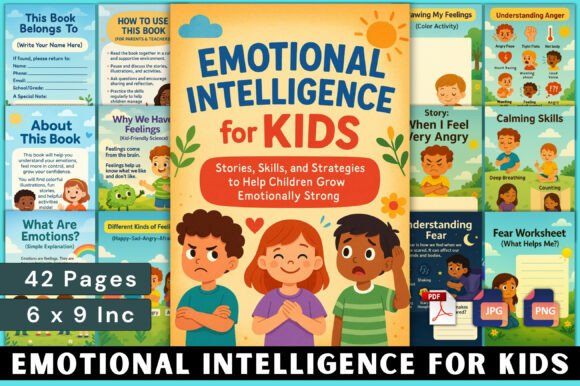
Emotional Intelligence for Kids: A Colorful Guide to Understanding Feelings, Growing Confidence, Building Kindness meets children where they are — on the rug during circle time, at the kitchen table after school, or curled up with a caregiver before bed. Its power lies in its simplicity and sincerity. Page 5 begins gently: “Feelings are messages from your body and heart.” No jargon. No abstraction. Just truth, illustrated with soft watercolor faces and expressive animals that mirror real childhood moments.
By page 6, children learn *why* emotions exist — not as flaws or interruptions, but as helpful signals: anger tells us a boundary was crossed; fear alerts us to possible danger; sadness helps us honor what matters. And by page 7, they’re naming emotions aloud — not just “happy” and “sad,” but “proud,” “shy,” “excited,” “overwhelmed,” and “hopeful.” Each word becomes a key to connection.
Where Emotions Live — Inside the Body, Not Just the Mind
One of the most grounding features of Emotional Intelligence for Kids is how it bridges emotion and physiology — without medical terms or diagrams. Page 8 invites children to notice: “When I feel nervous, my hands get sweaty. My tummy feels fluttery. My voice gets quiet.” This somatic awareness is foundational. Children who can identify physical cues early — a clenched jaw, shallow breathing, tight shoulders — gain precious seconds to pause before reacting.
This isn’t theory. It’s practice. A child who recognizes their racing heart before a spelling test can try the “Balloon Breath” activity (page 13) — inhaling slowly like filling a balloon, holding gently, then exhaling like letting air out with a soft “whoosh.” Another might trace calming patterns on their palm (“Starfish Calm”) when overwhelmed. These aren’t quick fixes — they’re lifelong tools, introduced with playfulness and respect.
Learning Through Doing — Not Just Reading
The workbook format of Emotional Intelligence for Kids transforms insight into action. Unlike passive storybooks, it invites participation on nearly every spread:
- Page 9 — “My Feeling Journal”: A simple chart where children draw or paste stickers to show how they felt each day — building emotional literacy through repetition and reflection.
- Page 10 — “What Makes Me Feel…?”: A gentle exploration of triggers. Instead of labeling behavior as “bad,” kids consider context: “I feel frustrated when my tower falls before I finish it.” This cultivates self-compassion and problem-solving.
- Page 11 — “Drawing My Feelings”: A coloring activity where children choose colors not to match moods (“red = angry”), but to express inner texture — swirling blues for loneliness, jagged yellows for excitement, soft purples for quiet contentment.
These aren’t busywork. They’re neural pathways being gently strengthened — helping children move from “I am angry” to “I am feeling anger right now, and that’s okay.”
A Vocabulary That Gives Voice
Page 12 holds one of the book’s quiet superpowers: a curated Feelings Word List with 30 kid-friendly emotion words — from “brave” and “grateful” to “confused,” “left out,” and “peaceful.” Why does this matter? Because research consistently shows that children with richer emotional vocabularies demonstrate greater empathy, lower aggression, and stronger peer relationships.
Think of it like this: If a child only knows the word “mad,” every intense feeling — disappointment, injustice, sensory overload — gets funneled into one explosive response. But with words like “disappointed,” “unfair,” or “too loud,” they gain precision — and with precision comes agency.
Big Emotions, Gentle Support
Anger and fear aren’t treated as problems to eliminate in Emotional Intelligence for Kids — they’re honored as vital parts of being human. Visuals on these pages avoid stereotypes: anger isn’t a red monster roaring; it’s a child sitting quietly with arms crossed, noticing heat in their cheeks. Fear isn’t a shadowy figure — it’s a small owl blinking in the dark, wide-eyed and watchful.
These images open doors for conversation, not correction. A parent might ask, “Have you ever felt like the owl? What helped you feel safe again?” A teacher might use the “Calm Corner Cards” (included in the back) to co-create a classroom space where big feelings are welcomed — not silenced.
Who Benefits — And Where It Fits In Real Life
Emotional Intelligence for Kids serves many roles — and that’s by design:
- At home: Parents use it during calm moments — not as crisis intervention, but as daily emotional “tuning.” Even five minutes together coloring a feeling or sharing one word about the day builds security and attunement.
- At school: Counselors integrate pages into social-emotional learning (SEL) lessons. Teachers use the “Feeling Check-In” prompts during morning meetings — no grading, no performance, just presence.
- In therapy: Clinicians appreciate its non-pathologizing language and trauma-informed pacing. It complements evidence-based approaches like CBT or play therapy — offering concrete metaphors and tactile anchors for abstract concepts.
- For neurodivergent children: The visual scaffolding, predictable structure, and emphasis on bodily awareness support kids with ADHD, autism, or anxiety — meeting diverse processing styles with flexibility, not rigidity.
Realistic Expectations — Strengths and Considerations
It’s important to say what Emotional Intelligence for Kids is — and what it isn’t. It’s not a replacement for professional mental health support when needed. It doesn’t promise overnight transformation. And it doesn’t assume all families have the same capacity — some days, just turning to page 8 and taking three breaths together is enough.
Its strength lies in accessibility — no special training required, no expensive materials. Its limitation? It works best when paired with adult modeling. A child learns far more from watching a caregiver name their own frustration and take a pause than from completing ten worksheets alone.
That said, even independent use has value. Many children return to favorite pages again and again — the “Kindness Jar” tracker, the “Worry Monster Tamer” drawing, the “Confidence Crown” cut-out — turning abstract ideas into tangible, repeatable rituals.
Final Thought: Emotional Strength Is Grown, Not Given
Emotional intelligence isn’t inherited like eye color or memorized like multiplication tables. It’s grown — through safety, repetition, curiosity, and care. Emotional Intelligence for Kids offers fertile ground: rich with color, low in pressure, high in compassion. It doesn’t ask children to be “better feelers.” It reminds them they already are — and gives them gentle, joyful ways to understand, honor, and express the beautiful, messy, ever-changing weather inside them.
Because when children learn early that their feelings matter — not just the easy ones, but the complicated, uncomfortable, overwhelming ones too — they don’t just survive childhood. They begin to thrive within it.